- Middle East and North Africa region could see rapid rollout of wind power by 2035
- Onshore wind capacity forecast to reach 40.5 GW by 2035, and could potential hit 72.5 GW
- Four countries lead demand and could be important centres for supply chain investments
17 November, Antalya | The Middle East and North Africa (MENA) region could rapidly expand electricity generation from wind power over the next decade, helping to boost energy security, electrification and industrial development while contributing to achieving climate and energy goals.
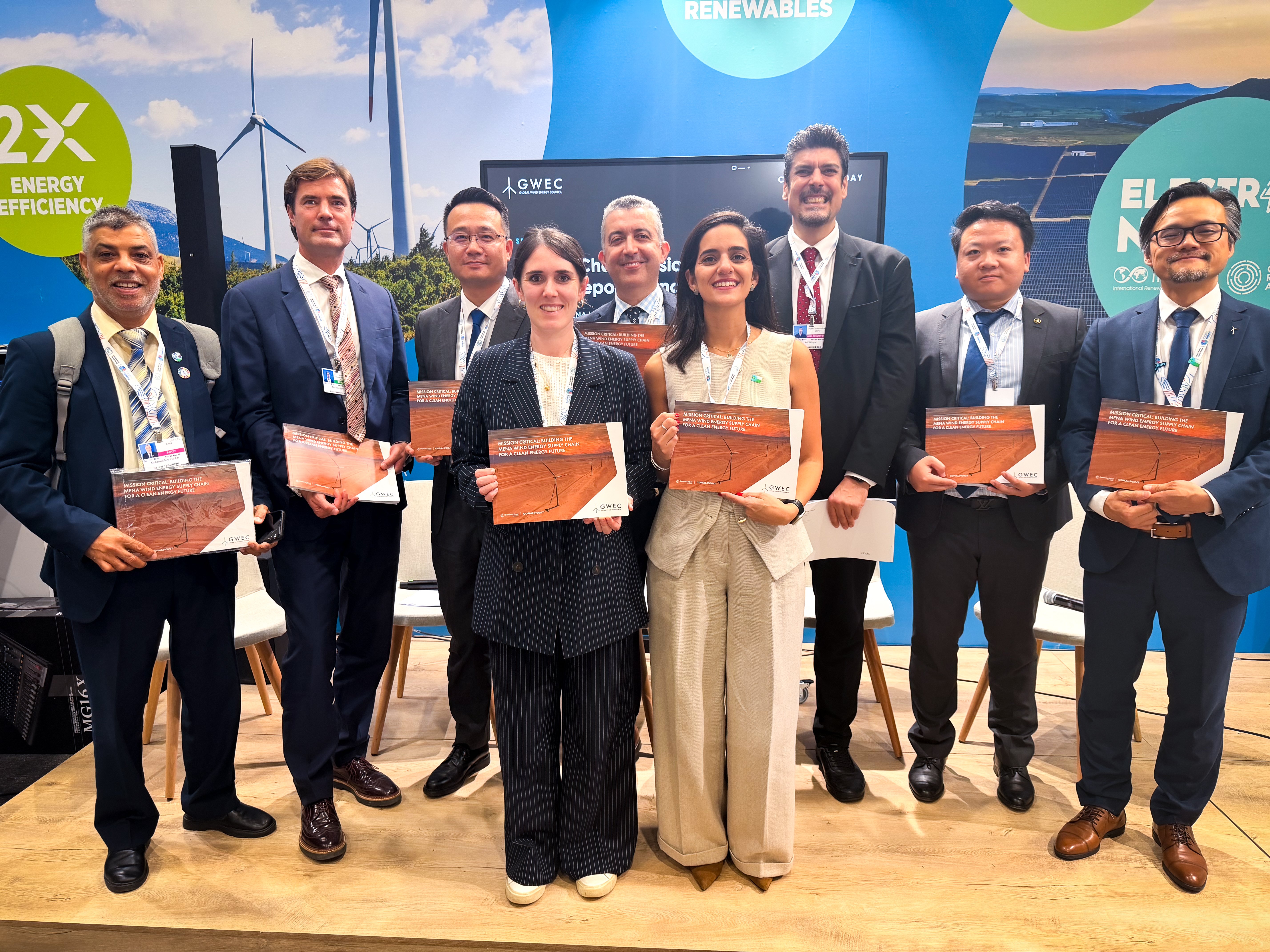
A new report, Mission Critical: Building the MENA Wind Energy Supply Chain for a Clean Energy Future, launched by the Global Wind Energy Council (GWEC) at COP31 in Antalya, Türkiye, identifies four countries – Egypt, Saudi Arabia, Morocco and Oman – where new onshore wind additions between 2026 and 2035 could rise by 31.6 GW between 2026 and 2035.
Under the report’s baseline scenario, the region’s total onshore wind capacity could reach 40.5 GW by 2035. This would represent a fivefold increase from the 7.4 GW that was operational by the end of 2025 and comes after annual installations across MENA reached a record 2 GW last year.
Under an accelerated growth scenario, assuming favourable conditions, including timely project delivery, continued procurement, supportive policies and fewer grid, financing and supply-chain constraints, the MENA region could see a tenfold increase in onshore wind capacity to reach 72.5 GW by 2035.
According to Ben Backwell, CEO of GWEC, the new GWEC report and modelling shows that countries across MENA have a significant opportunity to electrify their economies, increase renewable energy generation and develop their industrial capabilities, supply chains and skilled workforce. “The energy transition is more than a shift in how electricity is generated. For MENA, it is an opportunity to support economic diversification, strengthen energy security and build new industries around the age of electricity. GWEC and its members will continue to work with governments, industry and partners across the region to help build the supply chains needed for a clean and just energy transition,” he said.
Heba Rabie, Director of Middle East and North Africa at GWEC, said: “This MENA Wind Supply Chain Assessment puts the region on the map as an emerging player in the global wind industry. We are no longer simply talking about the potential for wind energy in the region, we have now been able to quantify the opportunities for investment and industrial development and can demonstrate how the growth of the wind sector can deliver wider economic benefits for the region.”
The report identifies that countries in MENA already have many of the manufacturing capabilities and industrial sectors that can support the development of a wind supply chain, including in blades, towers and foundations. For example, Morocco has an operating blade factory in Nador, while Egypt and Saudi Arabia have established tower manufacturing facilities. Foundations are also supplied locally across all four priority countries.
The report’s assessment, which was produced in partnership with Chemonics Eqypt Consultants and CoralPoint, identifies that an annual component supply gap of approximately 3.2 GW across most components would require an estimated US$ 505 million to 924 million investment in manufacturing capacity, particularly in gearboxes, bearings, generators, converters, and pitch and yaw drives. Under the accelerated deployment scenario, this requirement could increase to US$ 980 million to 1.53 billion.
New manufacturing initiatives are already planned or under development in Saudi Arabia, Egypt and Oman and these include partnerships that could bring additional manufacturing capacity to the region. Investment announcements alone will not be enough, however. Manufacturers require a clear view of future demand and access to finance.
The report concludes with a suite of national and regional recommendations for governments and public authorities, developers, manufacturers, supply chain businesses and development finance partners. These include the following key recommendations:
- Link renewable-energy deployment more closely to industrial development and local manufacturing opportunities
- Develop supplier-development programmes
- Improve visibility of demand, including beyond generation capacity
- Build an integrated regional supply chain around existing strengths
- Strengthen regional coordination and market intelligence
- Use public finance and guarantees to reduce early-entry risk
- Publish clearer project and procurement signals
- Demonstrate and communicate early successes
- Enhance inter-regional logistics infrastructure in alignment with component requirements
- Expand grid infrastructure and flexibility in step with wind deployment
Download and read the report from GWEC’s website: https://www.gwec.net/reports
About GWEC
GWEC is a member-based organisation that represents the entire wind energy sector. The members of GWEC represent over 1,500 companies, organisations and institutions in more than 80 countries, including manufacturers, developers, component suppliers, research institutes, national wind and renewables associations, electricity providers, finance and insurance companies.

Alexander Bath
Communications Director-

alex.bath@gwec.net

Will Henley
External Affairs Director-

will.henley@gwec.net
Share article:


Related articles
13 November, 2026
COP31: Global Wind Industry Unites Behind Declaration to Accelerate Clean Energy
16 November, 2026